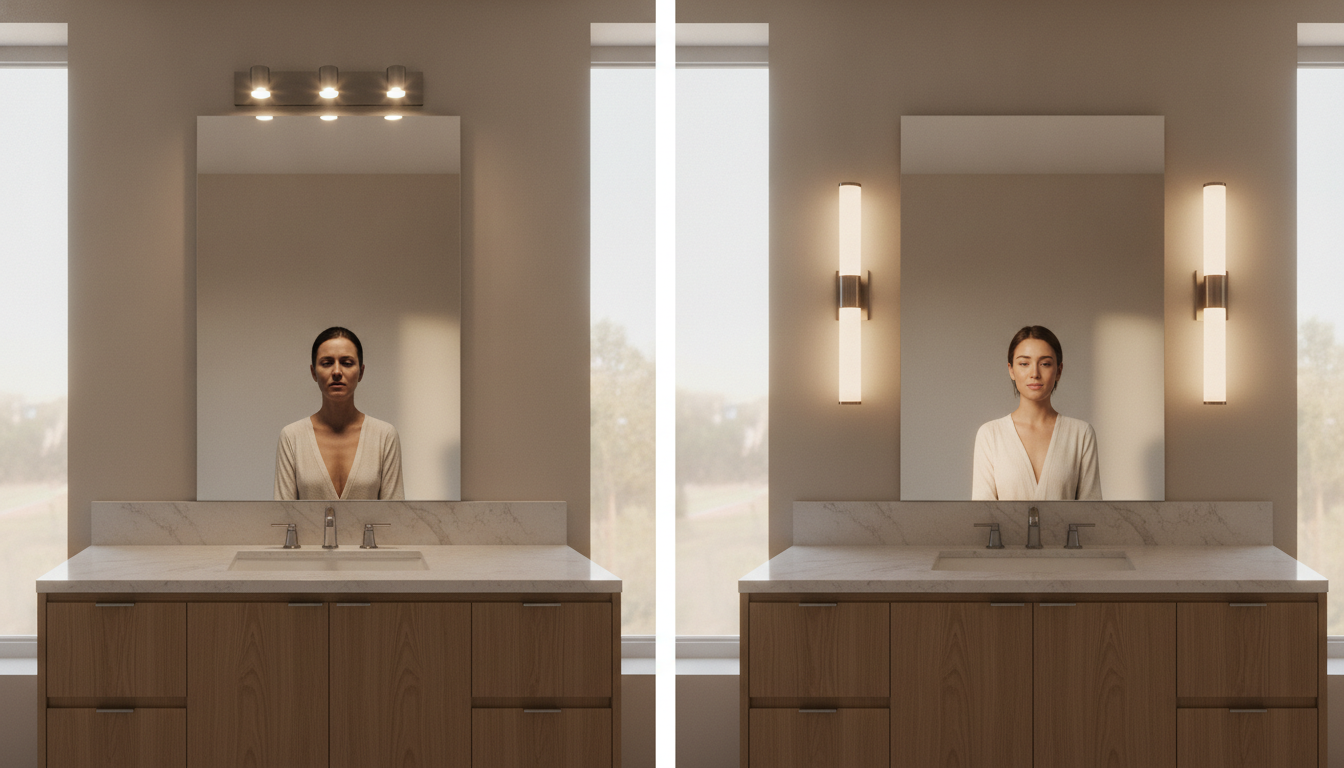
Most homeowners spend weeks choosing the perfect bathroom vanities with lights in mind, only to realize after installation that something feels off. The mirror is washed out. Shadows fall across the face at exactly the wrong angle. The cabinet finish that looked warm in the showroom now reads flat and cold. The fixture wasn’t the problem. The placement was. And that single decision — where the light sits relative to the cabinet, the mirror, and the person standing in front of it — matters far more than how many lumens are on the spec sheet.
Quick Answer
Bathroom vanity lighting works best when fixtures are mounted at eye level on the sides of the mirror rather than directly above it, because side-mounted sconces eliminate facial shadows, distribute light evenly across the cabinet face, and interact more naturally with your chosen cabinet finish. Wattage matters far less than position, colour temperature, and how the light bounces off your specific cabinetry and countertop materials.
Why the Cabinet Finish Changes Everything About Your Lighting Choice
Your cabinet finish is the single biggest variable in how bathroom light behaves. A high-gloss white cabinet will reflect and amplify light, sometimes aggressively, while a matte charcoal finish will absorb it. Neither is wrong. But if you choose your fixture without accounting for the finish, you will either end up with a bathroom that feels clinical and overexposed, or one that feels dim despite adequate wattage.
At Trending Kitchen Cabinets, we walk clients through this conversation during the 3D design phase, before anything is cut or built. When a homeowner sees how a warm-toned wood veneer cabinet renders under a 2700K bulb versus a 4000K bulb in a rendered model, the difference is immediately clear. That kind of visualization saves real money and prevents the kind of regret that shows up six months after a bathroom renovation is complete.
Here is the practical breakdown by finish category:
Gloss and semi-gloss finishes act like a secondary light source. They bounce light back into the room, which is useful in smaller bathrooms but can create glare when fixtures are placed directly above and aimed downward. For these cabinets, side-mounted lighting at eye level (roughly 60 to 65 inches from the floor) reduces glare while still taking advantage of the finish’s reflectivity.
Matte and satin finishes absorb more light and require slightly higher lumen output to achieve the same perceived brightness. These finishes are popular right now for good reason — they photograph beautifully and feel sophisticated in person — but they need fixtures that can compensate for the absorption. Warmer bulb temperatures (2700K to 3000K) tend to complement matte finishes better than cooler tones, which can make the surface look chalky.
Wood tones and stained finishes reward warm lighting more than any other category. Cool white light strips the warmth from natural wood grain and makes it look closer to laminate. If you have invested in real wood cabinetry for your bathroom vanity, the wrong bulb temperature is the fastest way to undermine that investment.
What Is the Right Height and Position for Bathroom Vanity Lighting?
The standard recommendation is side-mounted fixtures at approximately eye level — between 60 and 65 inches from the finished floor — flanking the mirror on both sides. This position lights the face from the left and right simultaneously, eliminating the shadow under the chin and brow that over-mirror fixtures create.
Over-mirror placement is not inherently wrong, but it is conditional. It works well when the mirror is wide and the fixture is a horizontal bar that spans most of the mirror’s width. A single overhead fixture above a narrow mirror on a double-sink vanity almost always creates shadows in the centre of the vanity, right where both people are trying to use it.
Side Sconces vs. Bar Lights: Which Performs Better?
Side sconces consistently outperform top-mounted bar lights for task lighting at a vanity. The reason is geometry. Light coming from the sides hits the face at a horizontal angle, which is how natural daylight enters a window beside a mirror. Light coming from above mimics overhead sun, which is not flattering and not functional for tasks like applying makeup or shaving.
That said, bar lights are more practical in smaller bathrooms where wall space beside the mirror is limited. If the bathroom is narrow and sconces would crowd the vanity cabinet or sit uncomfortably close to a side wall, a wide horizontal bar mounted above the mirror at a height of at least 75 to 78 inches (above the door trim, ideally) is a reasonable compromise — provided the bar is long enough to extend slightly past both edges of the mirror.
How Cabinet Depth Affects Shadow Zones
This is a detail that rarely gets discussed but consistently surprises homeowners. A deeper vanity cabinet — say, 24 inches versus the standard 21 inches — pushes the person standing at the sink slightly further from the mirror. That added distance means that overhead lighting creates longer shadows across the face before the light reaches it. If you have opted for a deeper custom vanity to gain storage, side sconces become even more important rather than optional.
Our team accounts for cabinet depth during the design phase for exactly this reason. The relationship between how deep a vanity sits, how the mirror is positioned, and where the lighting falls is part of the same design conversation — not three separate decisions made at three different times.
How Colour Temperature Interacts With Countertop and Cabinet Materials
Colour temperature — measured in Kelvin — determines whether your bathroom reads warm and inviting or bright and clinical. The right temperature depends on your specific combination of cabinet finish, countertop material, and how the room is used.
The range most relevant to bathrooms runs from 2700K (warm white, similar to incandescent light) through 4000K (neutral to cool white, common in offices). Most bathroom design professionals recommend staying between 2700K and 3000K for residential vanity lighting, with 3000K being a useful middle ground that reads as clean and bright without feeling institutional.
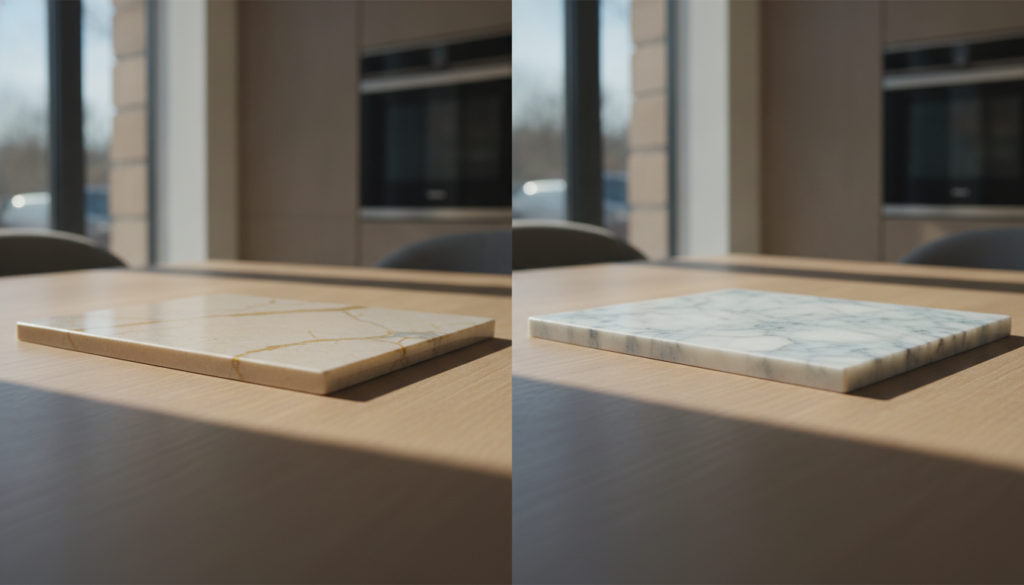
The countertop material you choose shifts the perceived colour temperature of the entire bathroom. White quartz under a 3000K bulb will read closer to 3500K because of the reflectivity of the stone. Dark granite under the same bulb will absorb that light and feel warmer. This means the fixture you choose should be calibrated to the full material palette of the room, not just the light bulb spec sheet.
For homeowners selecting bathroom vanities and lights at the same time (which is the right approach), the most reliable method is to bring material samples together: a cabinet door sample, a countertop swatch, and the actual bulb you plan to use. Hold them together under that light before committing. This is exactly the kind of review our 3D design process makes possible at the visualization stage, where all materials are rendered together under simulated lighting conditions.
For more context on how cabinetry, countertops, and fixtures need to be coordinated from the start, the Bathroom Remodel Planning Guide: Cabinets, Vanities, and Countertops That Work Together covers that full coordination process in detail.
Why Mirror Size and Placement Determine Whether Your Lighting Plan Works
The mirror is not a passive element in a vanity lighting plan. Its size, edge placement, and distance from the cabinet face all determine whether the light you install lands where it needs to.
A common mistake is choosing a mirror that is narrower than the vanity cabinet beneath it. This creates visual imbalance and, more practically, leaves the outer sections of the cabinet face in relative shadow, making the vanity feel smaller than it is. The general guidance is to select a mirror that sits within two to four inches of the vanity cabinet’s width on each side. For a 48-inch double-sink vanity, a mirror between 40 and 44 inches wide strikes the right proportion.
Mirror-integrated LED lighting — built into the mirror frame or behind a floating mirror as backlight — has grown significantly in popularity for Mississauga bathrooms over the past few years. These systems can work beautifully, but they function best as ambient or accent lighting rather than primary task lighting. The even, perimeter-distributed light from a backlit mirror tends to be diffuse. It creates a lovely glow but does not direct enough concentrated light to the face for precision tasks. Pairing a backlit mirror with side sconces gives you both: atmosphere and functionality.
The Gap Between the Mirror and the Cabinet Top
Where the mirror sits in relation to the top of the vanity cabinet matters for lighting more than most people expect. A mirror mounted too low leaves the backsplash tile visible between the cabinet top and the mirror bottom, and forces any overhead fixture to aim at a steeper downward angle to clear the top of the mirror. Standard practice is to mount the mirror four to eight inches above the countertop, giving the backsplash space to breathe while positioning the mirror at a usable height for most adults.
In older Mississauga homes where bathroom ceilings may be lower than modern builds, this calculation becomes more constrained. Our team frequently works with existing ceiling heights and older structural layouts to find the right mounting heights — it is one of the reasons we design custom rather than specifying standard off-shelf heights.
How to Plan Bathroom Vanity Lighting Before the Cabinet Is Built
The single most effective thing a homeowner can do is make lighting decisions during the cabinet design phase, not after installation is complete. Electrical rough-in happens before tile, before the cabinet goes in, and well before the mirror arrives. If the fixture placement is an afterthought, you are routing wires around decisions already made rather than making decisions together.
When we build a custom bathroom vanity for a client, the lighting conversation starts at the first design meeting. Where are the junction boxes going? How wide is the mirror? Are we doing side sconces, an overhead bar, or a combination? Is the client interested in in-mirror LED integration? These questions shape the cabinet dimensions, the mirror proportions, and the tile layout. Answering them in sequence — cabinet first, mirror second, lighting third — usually produces compromises that could have been avoided.
Our 3D design visualization process renders all of these elements together before any manufacturing begins. A homeowner in Mississauga can see exactly how the cabinet finish reads under the chosen light temperature, how the mirror proportions relate to the vanity below, and where shadows fall in the specific layout of their bathroom. That visibility before commitment is not a luxury feature — it is how good design decisions get made.
For homeowners thinking through the broader scope of a bathroom renovation, the guide on Bathroom Renovations in the GTA: What to Budget, Plan, and Prioritize is a useful companion to this topic, covering the full sequence of decisions from budget through execution.
The same principle that applies to lighting applies to every other element of a bathroom renovation: decisions made in isolation produce results that feel disconnected. The bathroom vanity, the countertop, the mirror, the tile, and the light fixtures are not separate purchases. They are one composition, and they perform best when they are designed as one.
If you are considering a vanity replacement or a full bathroom renovation and want to see how lighting, cabinetry, and countertop materials work together in your specific space, that is precisely what our design process is built to show you.
Ready to Design a Bathroom Vanity That Gets the Details Right?
At Trending Kitchen Cabinets, we design, manufacture, and install custom bathroom vanities from our Mississauga workshop — with 3D visualization, a fixed written price, and a team that handles every step under one roof. If you are planning a bathroom renovation and want to see your cabinetry, countertop, and lighting all working together before anything is built, we would be glad to walk you through the process.
Written by the Trending Kitchen Cabinets Design Team — Our team designs, builds, and installs custom cabinetry and bathroom vanities from our Mississauga workshop, working directly with homeowners across the GTA from first concept through final installation. Every article reflects the real questions and decisions we work through with clients every day.
Frequently Asked Questions
How high should bathroom vanity lighting be mounted?
Side-mounted sconces should be positioned at approximately 60 to 65 inches from the finished floor, which corresponds to eye level for most adults. This height ensures light reaches the face from a horizontal angle rather than overhead, eliminating shadows across the brow and chin. If you are mounting a horizontal bar above the mirror instead, the bottom of the fixture should clear the top of the mirror and sit at least 75 inches from the floor to avoid directing light steeply downward.
What colour temperature is best for bathroom vanity lighting?
Most bathroom design professionals recommend a colour temperature between 2700K and 3000K for vanity lighting. This range reads as warm white to neutral white — bright enough for task use without feeling harsh or institutional. The right choice within that range depends on your cabinet finish and countertop material: lighter, more reflective surfaces benefit from staying closer to 2700K, while darker or more absorbent finishes can handle 3000K without feeling cold.
Why does my bathroom feel dim even with enough wattage?
Perceived dimness in a bathroom is almost always a placement and direction issue rather than a wattage issue. If a single fixture is mounted directly above the mirror and aimed downward, most of the light hits the top of the head and the countertop rather than the face and the cabinet surface. Adding side sconces at eye level — or switching to a wide horizontal bar that spans the mirror width — will typically solve perceived dimness without increasing wattage at all.
Can I add side sconces to an existing bathroom vanity without a full renovation?
Yes, in many cases — but it depends on where your existing electrical rough-in is located. If junction boxes are already present on the side walls beside the mirror, adding sconces is relatively straightforward for a licensed electrician. If the wiring only runs above the mirror, adding side sconces will require new electrical work inside the wall, which typically involves opening drywall. This is one of the reasons we recommend addressing lighting placement during a vanity renovation rather than after, since the walls are already open and the cost of routing new wiring is minimal compared to doing it as a separate project later.