Why Quartz Countertops Dominate GTA Kitchen Renovations
Walk into almost any recently renovated kitchen in Mississauga and you will likely find countertops quartz surfaces running along the perimeter. The material has become the default upgrade for GTA homeowners — and not by accident. Quartz slabs combine the visual weight of natural stone with a surface that resists staining, scratching, and bacteria without annual sealing. That combination of beauty and low maintenance is hard to argue with, especially in a busy family kitchen.
But choosing quartz is only the first decision. Once you commit to the material, a cascade of practical choices follows: Which colour family suits your cabinetry? Should you go with a 2 cm or 3 cm slab? Polished or matte finish? What edge profile ties the room together without looking dated in five years? These choices affect both the final look and the final invoice, and they are worth thinking through carefully before anything is cut or installed.
At Trending Kitchen Cabinets, we work through these decisions with every client before manufacturing begins — using 3D design visualization so you can see exactly how each option lands in your space. This article breaks down each variable clearly so you arrive at that conversation informed and confident.
Quick Answer
Quartz countertops come in four main colour families (white/light, grey, beige/warm, and bold/dark), two primary thicknesses (2 cm and 3 cm), three common finishes (polished, honed, and leathered), and a range of edge profiles from simple eased to decorative ogee. The right combination depends on your cabinet style, lighting, budget, and how much visual texture you want in the room.
What Are the Main Quartz Colour Families and Which Works Best?
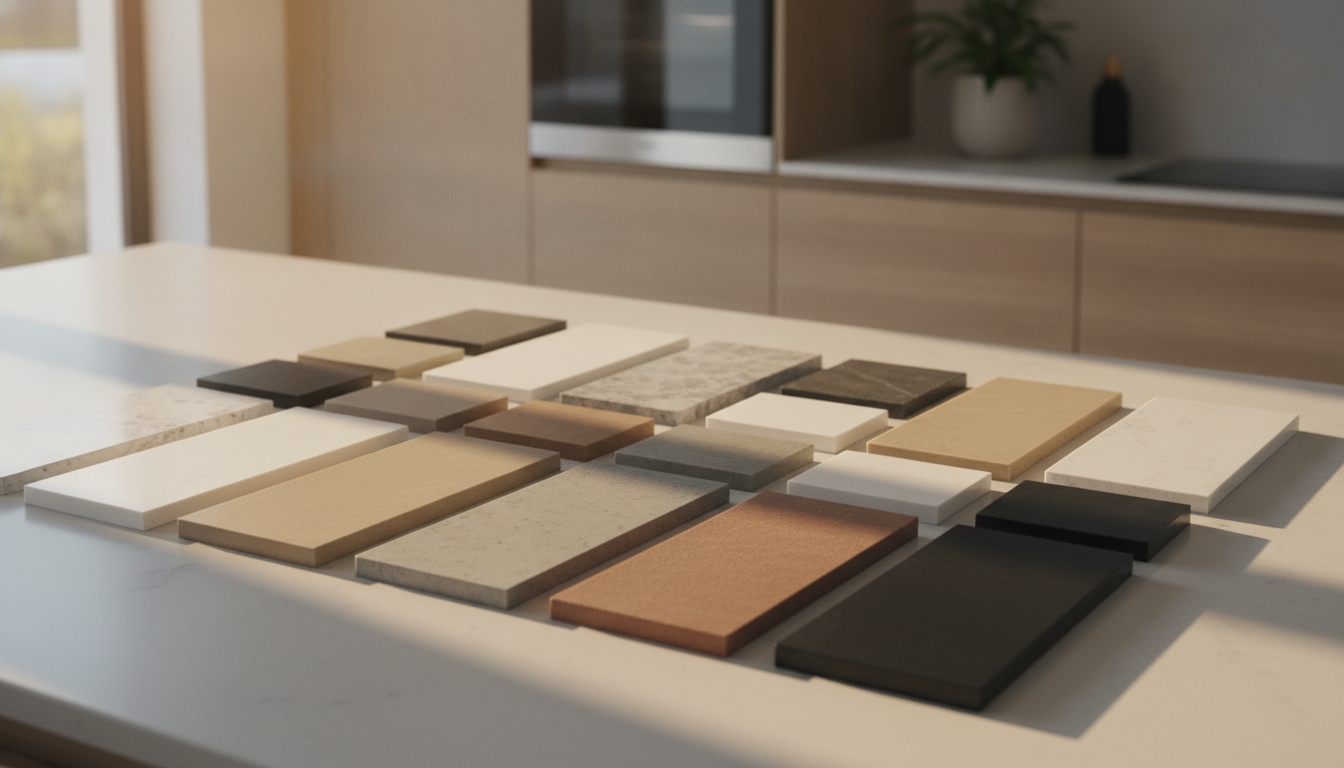
Quartz colour falls into four broad families, each of which works differently depending on your cabinetry, lighting, and overall design direction. The right colour is not purely aesthetic — it also affects how much maintenance the surface appears to need and how it ages visually over time.
White and Light Neutrals
White quartz — think Calacatta-inspired veining on a bright white base — is consistently the most requested colour in kitchen renovations we handle in Mississauga. It reflects light into smaller spaces, pairs with almost any cabinet colour, and reads as clean and modern without committing to a trend. The tradeoff is visibility: coffee rings and turmeric stains show up faster on a stark white surface than on a mid-tone. A warm white or light cream quartz gives you the same brightness with slightly more forgiveness.
Grey Tones
Grey quartz has held steady in popularity because it bridges classic and contemporary design effortlessly. Light greys work well over white or off-white cabinetry, while medium-to-dark greys create strong contrast against two-tone kitchens with lighter upper cabinets. Grey with subtle veining reads closest to a natural quartzite stone countertops look — which matters to homeowners who love natural stone aesthetics but want the durability of engineered quartz.
Beige, Cream, and Warm Earth Tones
Warm-toned quartz is making a strong comeback, particularly in kitchens with wood-toned or painted shaker cabinets. Beige and sand-coloured options feel grounded and inviting rather than stark, and they tend to hide everyday marks well. If your kitchen gets warm afternoon light — common in many west-facing Mississauga homes — a warm quartz will complement that naturally rather than fighting it.
Bold and Dark Tones
Charcoal, black, and deep forest green quartz have become a serious design choice rather than a niche one. Dark countertops with light cabinetry create the kind of high-contrast kitchen that photographs well and ages gracefully. The practical consideration is fingerprints: polished dark surfaces show smudges readily, which is one reason many homeowners who choose bold quartz pair it with a matte or honed finish.
How Does Quartz Thickness Affect Look, Strength, and Cost?
Quartz slabs are typically available in two thicknesses: 2 cm (roughly 3/4 inch) and 3 cm (roughly 1-1/4 inch). The choice affects structural performance, visual presence, and project cost in meaningful ways.
A 3 cm slab is the standard for most kitchen countertop installations today. It is thick enough to span unsupported runs without flexing, holds up to impact, and delivers a substantial, high-end look at the edge. It also eliminates the need for a plywood substrate in most cases, which simplifies installation. For bathroom vanities and laundry surfaces, 3 cm still works beautifully and gives countertops visual weight that feels intentional rather than incidental.
A 2 cm slab is thinner, lighter, and typically less expensive per square foot. It is a reasonable choice for vertical applications, low-traffic surfaces, or projects where budget is a priority. However, 2 cm installations over long spans require a full plywood substrate for support, and the edge profile options are more limited because there is simply less material to work with.
Some fabricators offer a workaround: a 2 cm slab with a mitered or laminated edge that mimics the appearance of 3 cm. This keeps material costs lower while maintaining the visual profile of a thicker slab. It is a legitimate option, but the seam at the edge should be discussed with your installer before committing.
“For most GTA kitchens, 3 cm quartz is the right starting point. It performs better across the board, looks more substantial, and the cost difference over the life of the kitchen is negligible.”
What Finish Should You Choose — Polished, Honed, or Leathered?
The surface finish on quartz changes how the colour reads, how the surface feels, and how much maintenance it requires day-to-day. There are three finishes worth understanding before you decide.
Polished
Polished quartz has a smooth, reflective surface that makes colours appear deeper and more saturated. It is the most common finish and the easiest to wipe clean — a damp cloth handles most spills without issue. The downside is that polished surfaces show fingerprints and water spots more readily, which some homeowners find frustrating in a heavily used kitchen.
Honed
A honed finish is matte rather than shiny, with a smooth but non-reflective surface. Colours appear softer and slightly lighter than the same quartz in polished form. Honed quartz is a popular choice for homeowners who prefer a more understated, natural stone aesthetic, and it hides everyday smudges much better than polished. It is worth noting that a honed surface can be slightly more susceptible to staining over time since there is no polished barrier, so prompt clean-up still matters.
Leathered
The leathered finish has a slightly textured, low-sheen surface that feels tactile and organic. It is the least common of the three finishes but increasingly popular in higher-end kitchen renovations and home bar applications. Leathered quartz hides fingerprints and water marks exceptionally well, though the texture requires a bit more attention when cleaning around grout-like surface variation. If you are after a surface that feels genuinely distinct, the leathered finish is worth considering.
How Do Edge Profiles Compare Across Style and Price?
Edge profiles are the detail most homeowners overlook until the countertop is being installed — and then it becomes very obvious. The edge profile you choose completes the transition between countertop and cabinet, affects how modern or traditional the kitchen reads, and in some cases changes the fabrication cost.
| Edge Profile | Visual Style | Best Suited For | Relative Cost |
|---|---|---|---|
| Eased / Straight | Clean, minimal, modern | Contemporary and transitional kitchens | Standard (included) |
| Beveled | Angled top edge, slight detail | Transitional kitchens, most cabinet styles | Low upcharge |
| Bullnose | Fully rounded, soft edge | Homes with young children, traditional kitchens | Low to moderate upcharge |
| Waterfall | Slab continues vertically to floor | Islands, modern statement kitchens | Significant upcharge (extra material) |
| Ogee | S-curve decorative profile | Traditional, classical kitchens | Moderate to high upcharge |
| Mitered / Laminated | Thick slab appearance from 2 cm material | Budget-conscious projects wanting thick-slab look | Moderate upcharge |
The eased or straight edge is the go-to for modern custom kitchen cabinets because its clean geometry does not compete with hardware, backsplash tile, or the cabinet door style. The ogee profile, once a staple of traditional kitchens, has become less common in new renovations but remains a solid choice when the rest of the kitchen leans classical. The waterfall edge is striking — but it is a commitment in both budget and style, so it should be considered as part of the overall design plan rather than added as a finishing thought.
Our team at Trending Kitchen Cabinets works through edge profile options during the 3D design phase so clients can see how each choice lands in context, not just on a sample board. That matters because an edge profile that looks elegant in isolation can feel out of proportion on a wide island or a compact bathroom vanity.
For more context on how countertop decisions fit into a broader kitchen renovation plan, the Modern Kitchen Design Trends GTA Homeowners Are Loving in 2026 article covers how surfaces, cabinetry, and hardware interact across the most popular design directions right now.
Is Quartz or Quartzite the Better Choice for Your Kitchen?
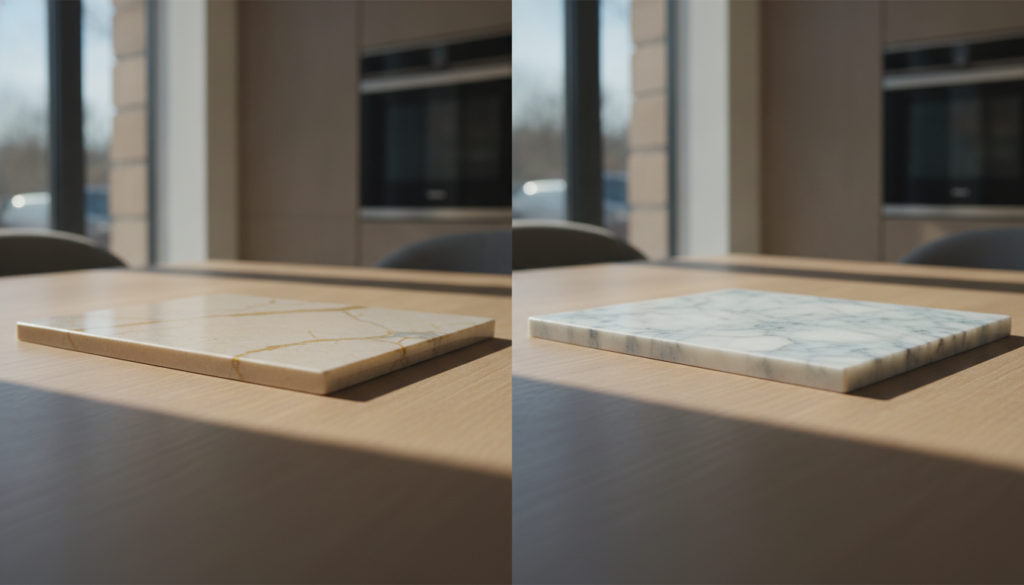
Engineered quartz and natural quartzite stone countertops are frequently confused, and the distinction matters when making a purchase decision. Engineered quartz is a manufactured product, typically composed of roughly 90 to 95 percent ground quartz particles bound with polymer resin. Quartzite is a 100 percent natural metamorphic stone, quarried in slabs, and each piece is entirely unique.
Natural quartzite offers organic variation, depth, and a tactile quality that engineered products replicate but do not fully reproduce. It is one of the hardest natural stones available and resists scratching well. However, quartzite is porous and requires sealing — typically once a year — and its pricing tends to be higher than standard engineered quartz, particularly for premium imported slabs.
Engineered quartz, by contrast, is non-porous from the factory, needs no sealing, and delivers consistent colour and pattern across the entire slab and from batch to batch. For homeowners who want the look of natural stone without the ongoing maintenance commitment, engineered quartz is the more practical answer. For homeowners who specifically want the character and authenticity of a natural material and are comfortable with periodic upkeep, quartzite is a compelling option worth pricing out.
We carry both options at Trending Kitchen Cabinets and are happy to show you real slab samples side by side so you can make the comparison with your own eyes, in your own light conditions, against your actual cabinet samples.
If you are planning a larger renovation that extends beyond the kitchen — including custom closets or bathroom vanities — the same countertop and surface decisions often carry through the home. Our article on Closet Shelving and Storage Systems: Custom Built-In vs. DIY Kits is a useful reference for thinking through the built-in versus stock question in adjacent spaces.
How Quartz Fits Into a Full Kitchen or Bathroom Renovation
A countertop does not exist in isolation. It sits alongside cabinetry, backsplash tile, hardware, lighting, and flooring — and the relationship between all of those elements determines whether the final result feels cohesive or disjointed. This is exactly why we incorporate countertop selection into our 3D design process rather than treating it as a separate finish decision at the end.
For homeowners exploring a kitchen renovation in Erin Mills or surrounding areas, one consistent challenge is that older homes in those neighbourhoods were built with non-standard dimensions: walls that are not quite square, floor plans that do not accommodate off-the-shelf cabinetry, and soffits that complicate standard upper cabinet heights. Custom cabinetry solves that at the cabinet level, and custom-cut countertops address it at the surface level. Mass-produced slabs cut to standard dimensions simply do not fit these kitchens cleanly.
The same logic applies to bathroom vanities. A standard 60-inch vanity top will not fit a bathroom that measures 58 and a half inches between walls. A custom-fabricated quartz vanity top cut to the exact dimension does. That level of precision is built into how we work, whether the project is a full kitchen renovation in Brampton, a bathroom update, or a home bar installation.
We also supply countertops for wall units and home bar surfaces where quartz makes an excellent choice for durability and cleanability — both important in high-use entertaining spaces. The design principles around colour, thickness, and finish apply equally in these contexts, and we work through those decisions the same way we do in a kitchen: with a fixed written price, a schedule commitment, and a 3D visualization before any material is ordered.
Ready to Choose Your Quartz Countertop?
Our team at Trending Kitchen Cabinets handles countertops as part of a complete kitchen or bathroom design — not as an afterthought. You will see your colour, thickness, finish, and edge profile choices rendered in 3D before any slab is ordered, and you will have a fixed written price before any work begins. We serve homeowners across Mississauga, Brampton, Burlington, and the broader GTA with the same hands-on, one-team process from design through installation.
About the Trending Kitchen Cabinets Team
The team at Trending Kitchen Cabinets designs, manufactures, and installs custom cabinetry and countertops for homeowners across Mississauga and the GTA. With a 5.0 Google rating and a process built around 3D visualization and fixed written pricing, the team brings professional craftsmanship and genuine personal service to every project.
Frequently Asked Questions
How thick should quartz countertops be for a kitchen?
For most kitchen installations, 3 cm (approximately 1-1/4 inch) is the recommended thickness. It is strong enough to span unsupported sections without flexing, requires no plywood substrate in most cases, and delivers a substantial visual presence at the edge. A 2 cm slab can work for lower-traffic surfaces or budget-sensitive projects but requires full substrate support and limits edge profile options.
What is the difference between quartz and quartzite stone countertops?
Engineered quartz is a manufactured surface made primarily of ground quartz bound with resin — it is non-porous and requires no sealing. Quartzite stone countertops are 100 percent natural metamorphic stone that must be sealed periodically to prevent staining. Quartzite offers unique natural variation and depth, while engineered quartz offers consistent colour, lower maintenance, and broader availability at most price points.
Why does the edge profile matter when choosing quartz?
The edge profile affects how modern or traditional the kitchen reads, how comfortable the surface is to lean against, and how much it adds to the fabrication cost. A clean eased or straight edge suits contemporary and transitional kitchens without competing with other design elements. Decorative profiles like ogee or waterfall make a stronger visual statement but carry a higher fabrication cost and work best when planned as part of the overall design rather than added at the last step.
Can I use quartz countertops in a bathroom vanity or home bar?
Yes, quartz is an excellent choice for bathroom vanities, home bars, wall units, and laundry surfaces. Its non-porous surface resists water, cleaning products, and cosmetic stains without sealing, which makes it well-suited to wet or high-use areas. The same colour, finish, and thickness decisions apply, and running the same quartz surface through multiple rooms in a home creates a unified, well-considered design that holds up over time.
Written by the Trending Kitchen Cabinets Team
Our team brings deep expertise — Design, Manufacture and installation of Kitchen cabinets.