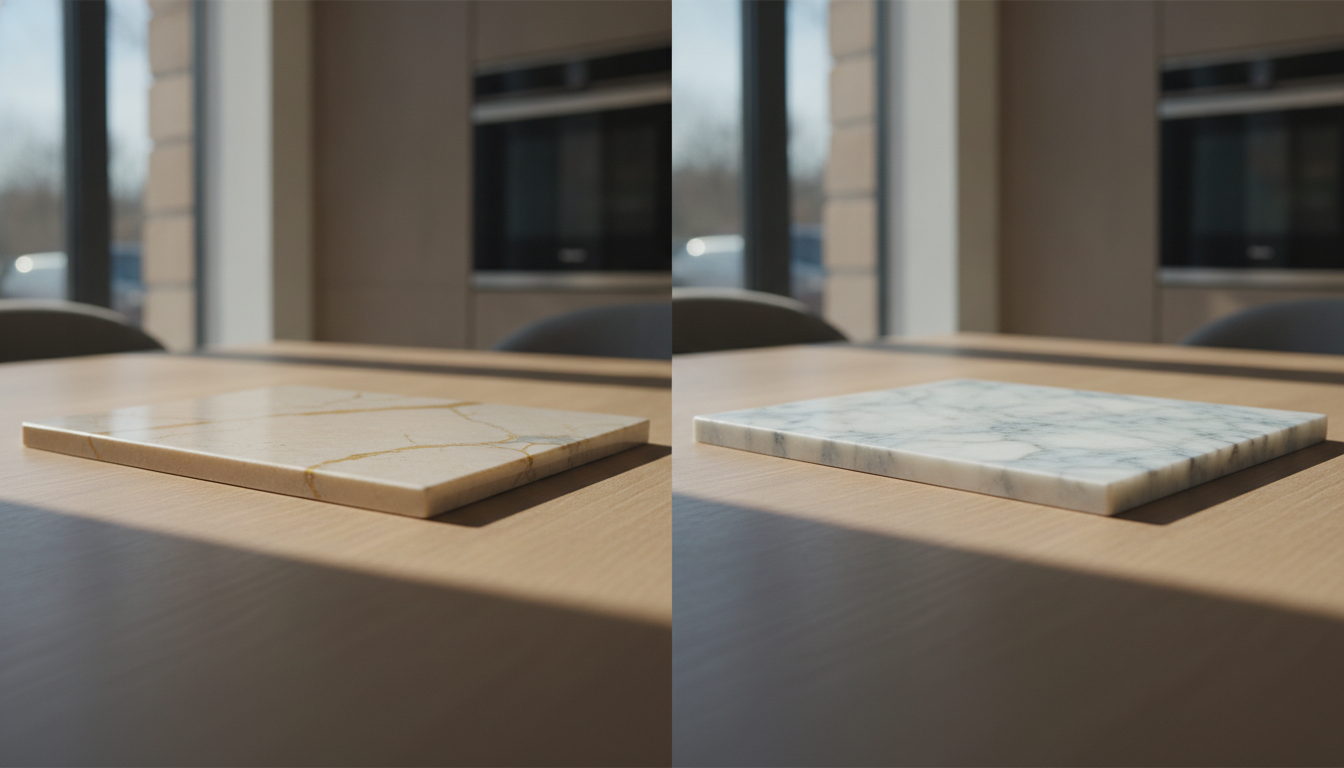
The Name Confusion That Costs Homeowners Real Money
Walk into almost any showroom and ask about quartzite stone countertops, and you will almost certainly be handed a brochure for quartz instead. The names sound nearly identical, the slabs can look similar on the shelf, and the sales conversation moves quickly. But these are two fundamentally different materials with different origins, different care requirements, different price points, and different long-term performance profiles. Choosing the wrong one for your kitchen is an expensive mistake that shows up slowly — in etching, staining, or surfaces that don’t hold up the way you expected. At Trending Kitchen Cabinets, we walk every Mississauga homeowner through this exact conversation before a single slab is selected, because the right countertop starts with understanding what you’re actually buying.
Quick Answer
Quartzite is a natural metamorphic stone quarried from the earth — harder than marble, with striking veining, but porous enough to need sealing. Quartz (sometimes called engineered stone) is a manufactured product made from crushed quartz crystals bound with resins, making it non-porous and virtually maintenance-free. Both are premium countertop choices; the right one depends on your lifestyle, design goals, and how much ongoing care you want to do.
What Exactly Is Quartzite — and Where Does It Come From?
Quartzite is a natural stone. It begins as sandstone and over millions of years transforms under intense heat and pressure deep within the earth into one of the hardest natural stones available for residential use. The result is a material with dramatic, flowing veining — often in whites, greys, and soft golds — that looks remarkably similar to marble but performs considerably better in high-traffic kitchens.
Because quartzite is quarried, every slab is unique. No two pieces are identical in pattern or tone. This is a significant part of its appeal for homeowners who want a countertop that feels genuinely one-of-a-kind. Popular quartzite varieties like White Macaubas, Sea Pearl, and Mont Blanc each carry their own distinct character, and when you see the slab in person, the depth of the stone is difficult to replicate with any manufactured material.
The key limitation of quartzite as a natural stone is porosity. Even though it is harder than granite on the Mohs scale, quartzite still absorbs liquids if left unsealed or if the sealer wears off over time. Acidic spills — lemon juice, vinegar, wine — can etch the surface if they sit long enough. This does not make quartzite a bad choice; it simply means it asks something of the homeowner in return for its beauty.
What Is Quartz (Engineered Stone) and How Is It Made?
Quartz countertops are engineered, not quarried. The manufacturing process combines roughly 90 to 95 percent ground quartz crystals with polymer resins and pigments, then compresses the mixture into slabs under controlled conditions. The result is a non-porous surface that resists staining, does not require periodic sealing, and maintains a consistent appearance across the entire slab.
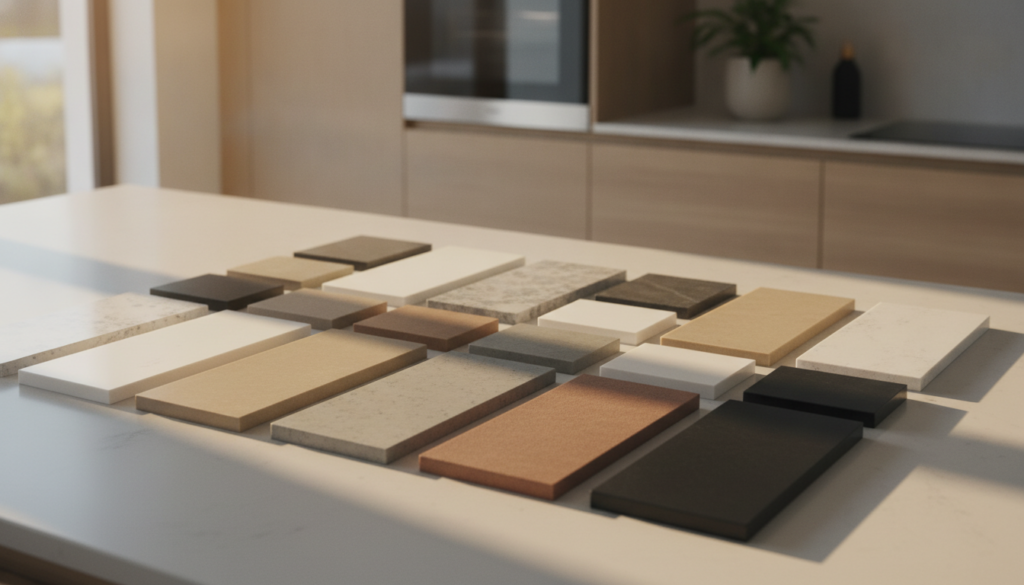
The engineering process also means that colour, pattern, and texture can be tightly controlled. Manufacturers can produce countertops quartz slabs that mimic marble veining, concrete textures, or solid tones that simply don’t occur in nature. For homeowners with very specific design requirements — a particular shade, a precise pattern repeat, or a matte finish — engineered quartz gives a level of predictability that natural stone cannot.
The main vulnerability of engineered quartz is heat. The resin binders used in manufacturing are not heat-resistant the way natural stone is. Placing a hot pan directly on a quartz surface can scorch or discolour the resin, leaving a permanent mark. Trivets and hot pads are a non-negotiable habit with quartz countertops. Beyond heat, quartz performs exceptionally well in everyday kitchen conditions — coffee spills, raw meat prep, and regular cleaning with standard household products cause no damage whatsoever.
How Do Quartzite and Quartz Compare Across the Details That Matter?
When homeowners are comparing these two materials seriously, the conversation usually comes down to five areas: durability, maintenance, appearance, cost, and suitability for different kitchen styles. The table below summarizes how quartzite and quartz stack up across those factors so you can make a clear-eyed decision before committing to either.
| Factor | Quartzite (Natural Stone) | Quartz (Engineered Stone) |
|---|---|---|
| Origin | Quarried natural metamorphic stone | Manufactured from crushed quartz and resin |
| Porosity | Porous — requires periodic sealing | Non-porous — no sealing required |
| Heat Resistance | Excellent — handles hot pots well | Poor — resin can scorch; always use trivets |
| Scratch Resistance | Very high — one of the hardest natural stones | High — but can scratch with abrasive tools |
| Stain Resistance | Moderate — good when properly sealed | Excellent — non-porous surface resists stains |
| Appearance | Unique per slab — natural variation throughout | Consistent and controlled — predictable pattern |
| Maintenance | Seal every 1–3 years; avoid acids on surface | Wipe clean daily; minimal long-term upkeep |
| Typical Cost Range (installed, CAD) | Generally higher — varies by slab rarity | Mid to high range — consistent pricing |
| Best Suited For | Design-forward kitchens; homeowners who cook carefully | Busy family kitchens; low-maintenance lifestyles |
Which One Is Right for Your Kitchen Style and Lifestyle?
The honest answer is that the right countertop material depends less on which one is “better” and more on how your household actually uses the kitchen. Both materials are premium choices worth the investment; the distinction is about fit.
When Quartzite Makes Sense
Quartzite is a compelling choice for homeowners who place high value on the irreplaceable character of natural stone. If you are drawn to the organic variation of veining — the way no two sections of a slab read exactly the same — quartzite delivers something that manufactured products genuinely cannot replicate. It also suits kitchens where the countertop is meant to be the visual centerpiece, particularly in designs that pair natural stone with custom cabinetry, wood accents, or other organic textures.
Quartzite also works well for homeowners who are mindful cooks — people who naturally use cutting boards, place trivets under pots, and wipe spills promptly. If you are willing to reseal the surface every year or two and treat the stone with a reasonable degree of care, quartzite will reward you with a surface that looks better with age rather than worse.
From a design standpoint, quartzite pairs beautifully with the kind of Modern Kitchen Design Trends GTA Homeowners Are Loving in 2026 — specifically the warm natural materials movement that has moved away from cold uniformity toward textured, layered interiors with genuine depth.
When Quartz Makes More Sense
Engineered quartz is the stronger choice for busy family kitchens where the counter is in constant use and low maintenance is a genuine priority. If your household includes young children, frequent entertaining, or simply a cooking style that involves a lot of acidic ingredients and fast cleanup, quartz removes the variables that come with natural stone. You will never worry about whether last night’s tomato sauce left a mark.
Quartz is also the better option when you need precise, consistent colour across a large kitchen with island, perimeter counters, and a waterfall edge. Because each slab is manufactured to spec, matching across multiple pieces is straightforward. With natural quartzite, variation between slabs is part of the material’s personality — which is a feature for some homeowners and a complication for others.
The countertop material you choose should suit the life you actually live in your kitchen — not the life you imagine you will start living once the renovation is done.
Why the Countertop Decision Belongs in the Design Process, Not at the End
One of the most common mistakes in kitchen renovation is treating the countertop as an afterthought — a finish-line decision made after cabinets are ordered and walls are already open. In practice, the countertop material should inform cabinet colour selection, edge profile choices, hardware finishes, and even lighting placement. A dramatic quartzite slab with bold veining asks for a quieter cabinet finish to let the stone breathe. A clean, solid-tone quartz can hold its own against more expressive cabinetry.
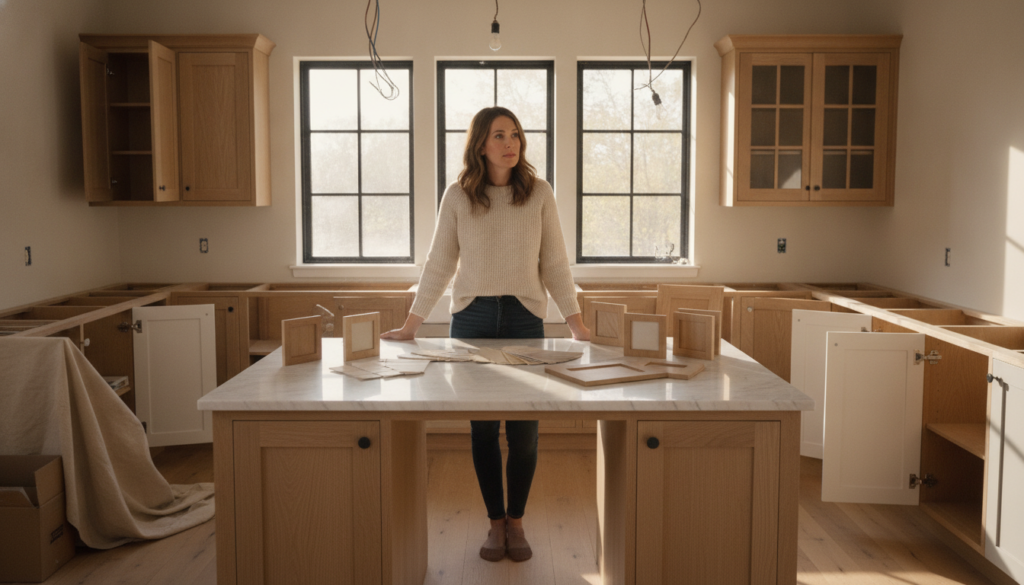
At Trending Kitchen Cabinets, we build the countertop conversation into the 3D design visualization stage — before anything is cut or manufactured. Homeowners see exactly how their selected stone looks alongside the cabinet finishes, door profiles, and hardware in a rendered view of their actual kitchen. This matters especially in older Mississauga homes where the floor plan is not perfectly square, and where the relationship between the countertop overhang, the island, and the sight lines from the adjacent living area needs to be worked through carefully before it becomes permanent.
Our team sources and installs countertops in quartz, granite, and marble — and we can walk you through the specific slab options that suit your cabinet design, your usage patterns, and your budget. The integration of cabinetry and countertops under one team means nothing gets lost in translation between trades, and the result reads as one cohesive design rather than a collection of separate decisions.
If you are early in your planning and still weighing your overall cabinet direction, our guide on Custom Kitchen Cabinets vs. Stock Cabinets: Which One Is Worth Your Money? is a helpful starting point for understanding why the cabinet foundation shapes every other decision in the room.
Is One More Durable Than the Other Over Time?
Durability is not a simple win for either material — it depends on what kind of wear you are measuring. Quartzite is harder on the Mohs scale than most engineered quartz products, which means it resists scratching and chipping from physical impact very well. It also handles heat from pots and pans without damage to the stone itself, making it genuinely forgiving in that specific scenario.
Engineered quartz, by contrast, is more resistant to staining and to the chemical effects of household acids and cleaning products. Its non-porous surface means that bacteria, moisture, and pigmented liquids do not penetrate the material under normal use. For a countertop in a kitchen where food safety and low maintenance are the primary concerns, that non-porosity is a meaningful advantage.
Over a decade or more, both materials hold up well when treated appropriately. The homeowners who experience the most dissatisfaction are usually those who chose a material without fully understanding its requirements — quartzite owners who skipped sealing, or quartz owners who placed hot cookware directly on the surface. Setting expectations clearly before installation is the most reliable path to long-term satisfaction with either choice.
Ready to Choose the Right Countertop for Your Kitchen?
Our team at Trending Kitchen Cabinets helps Mississauga homeowners compare countertop materials, see them in context with their cabinet design through 3D visualization, and make confident decisions before anything is manufactured. We handle design, cabinetry, and countertop installation under one roof with one written price — no surprises, no gaps between trades.
Written by the Trending Kitchen Cabinets Design Team — our designers and craftspeople work together from initial concept through final installation on every project we take on. We share what we know because an informed homeowner makes better decisions, and better decisions lead to kitchens that hold up beautifully for years.
Frequently Asked Questions
How often does quartzite stone need to be sealed?
Most quartzite stone countertops benefit from resealing every one to three years, depending on usage and the specific stone’s density. A simple water bead test tells you whether your sealant is still effective: if water soaks into the surface rather than beading up, it is time to reseal. The process takes a couple of hours and is straightforward enough for most homeowners to do themselves.
What happens if I put a hot pan directly on a quartz countertop?
Placing a hot pan or baking dish directly on a countertops quartz surface can scorch or permanently discolour the resin binders in the material. The damage is usually a whitish or yellowed patch that cannot be repaired without professional intervention, and in some cases cannot be fully reversed. Using trivets or silicone mats consistently is the simplest way to avoid this issue entirely.
Why do quartzite and quartz look so similar in showroom photos?
Engineered quartz manufacturers have become very skilled at replicating the visual character of natural stone, including quartzite veining. In a small sample or a compressed photograph, the two can be nearly indistinguishable. The difference becomes clearer when you see a full slab in person: natural quartzite has a depth and three-dimensional quality to its veining that the manufacturing process cannot fully reproduce. Viewing full slabs at a supplier, rather than relying on digital images, is always recommended before making a final selection.
Can I use the same countertop material in my kitchen and bathroom vanity?
Yes, and many homeowners choose to do exactly that for a cohesive look throughout the home. Both quartzite and quartz perform well in bathroom environments, though quartz is particularly popular for bathroom vanities because its non-porous surface handles daily water exposure, cosmetics, and cleaning products without maintenance concerns. If you are planning a full renovation that includes both the kitchen and bathroom, coordinating the stone selection across both spaces early in the design process can save time and reduce material waste.